
Running Two Amps at Once: ABY Boxes, Phase, and What Didn't Work in 2001
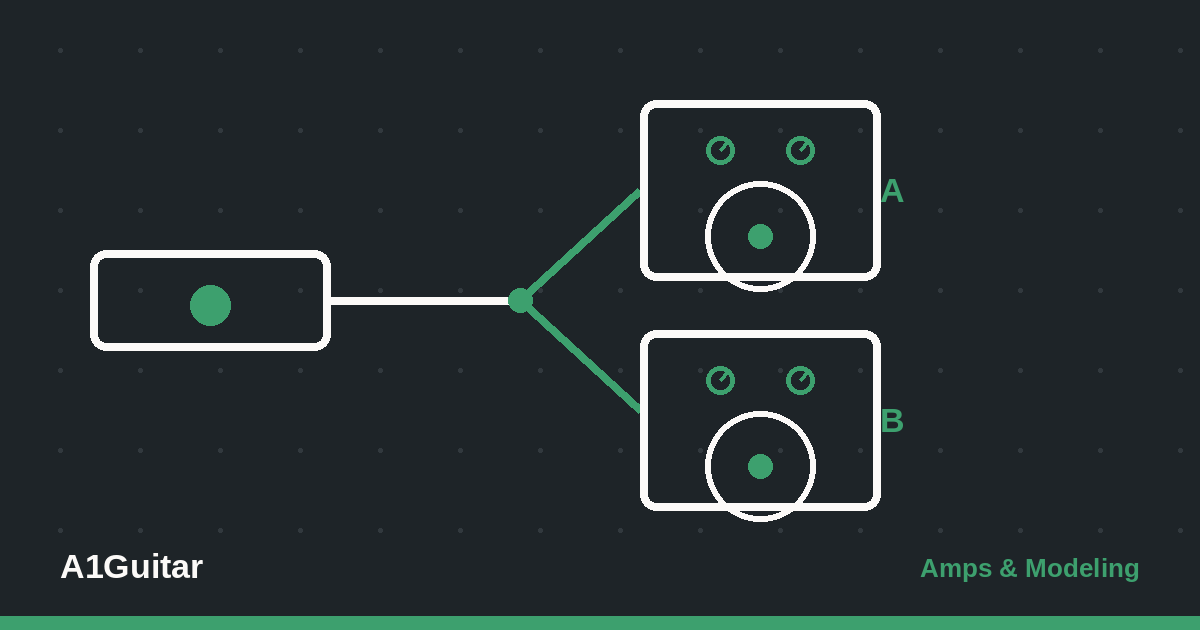
In May 2001 someone on alt.guitar.amps asked about running two amps at once, and I had tried it, so I answered. This is the longer version, with my 2001 experience kept dated and the hardware side checked against what a current ABY pedal actually does.
What I tried in 2001
I tried a volume trade-off between a distorted Budda and a cleaner Top Hat, with one amp fading up as the other faded down, so I could move from one sound toward the other. In theory that gives you a smooth sweep from clean to dirty. In practice I did not like what it did. I wrote at the time that the trade-off did not work the way I wanted, and that the sweep did not sound natural.
Why it did not work
I had two explanations. The first is that amps have a built-in compression effect. Once an amp distorts, its output volume no longer moves in step with the input volume, so an even blend of two amps does not behave like an even blend of two clean signals.
The second is the one I still find most interesting. In the middle of the sweep, each amp gets about half the signal. The distorted amp is not driven hard enough to distort, so it stops sounding like the amp I wanted. The clean amp is quieter, and it is not being driven either, so it is not as good a tone. I noticed that some middle positions were actually cleaner than the setting that sent everything to the clean amp, which I called really strange.
My conclusion then was that the blending should happen after the preamps, and ideally after the power amps. The other way out was to use two amps that react better to a low signal, such as two cleaner amps.
ABY boxes and phase
That same thread was also about splitting one guitar signal into two amps without a crossfade. I wrote that I had heard from several sources that a plain ABY box can cause phase problems when it splits to two amps. A guitarist friend of mine swore he had tried several boxes and had problems. I also wrote that a standard passive Y cable can pull almost half your guitar signal, that active boxes were better, and that a bad phase problem can leave you with a thinner tone than either amp alone. I accepted that a buffer was a trade-off, since many pedals have buffers and plenty of players already live with that.
One side note from the same thread: a tuner pedal that passes signal when there is no battery should not hurt your tone, while one that cuts off without power can be a problem. That was my old Korg, so take it as one data point.
What the hardware does now
Those are my 2001 claims, and I have not re-tested them. What I can do is show you what a current box does about the same two problems. The Radial BigShot ABY is a good example because its feature list reads like a response to my old complaints. According to Radial, it has:
A, B and Y modes. Two latching footswitches let you pick one amp or run both at once.
A polarity switch. A 180 degree polarity reverse switch is there to help the two amps play in phase and avoid frequency cancellation. That is the thin-tone problem I was hearing about in 2001.
A ground lift and isolation transformer. The second amp output has both, to reduce hum and buzz from ground loops.
No buffers. Radial says the audio path is passive and true bypass, so nothing sits between the guitar and the amp. It works without power; the LEDs need a 9 volt supply.
That description is the maker's, not mine. I am using it here to show where the trouble spots are, not to recommend one box over another. If you want to read more about why buffers matter, see buffer vs true bypass.
Before you buy a second amp
Decide what you want from two amps. If it is two different sounds at once, that is a different job from switching between two amps, and in 2001 I learned that the blend is where it goes wrong.
Listen to the polarity switch. With both amps playing, flip it and keep the position that sounds fuller. The point of the switch is to let your ears decide.
Mind the hum. If you hear a buzz that was not there with one amp, a ground lift is the first thing to try, and it is the reason the isolation and lift controls exist.
Check your modeler first. If you are on a modeler and want two sounds at once, find out whether yours can build two parallel paths before you buy another amp. I have not tested that on every unit, so check the manual for yours. Our FRFR explainer covers the powered-cab side of that setup.
Frequently asked questions
Can you run two guitar amps at once?
Yes. An ABY box or a switcher with a Y position sends the guitar signal to both amps at the same time. The common problems are thin tone from phase cancellation and hum from ground loops.
Why does my tone get thinner with two amps?
It can be a phase problem. When the two amps are out of polarity with each other, some frequencies cancel. Radial builds a 180 degree polarity switch into its BigShot ABY for this reason, so you can flip it and listen.
How do I stop hum when running two amps?
Hum between two amps is often a ground loop. Radial's BigShot ABY has a ground lift and an isolation transformer on its second output to reduce it.
Keep reading
-
Buffer vs True Bypass: What Actually Matters for Your Tone
What a buffer actually does to your signal, when true bypass helps and when it quietly hurts you, and how to figure out what your board actually needs.
-
What Is an FRFR Speaker? The Missing Piece of Your Modeler Rig, Explained
FRFR means full range, flat response: a neutral powered cab that lets your modeler's cab sim do the talking. What it is, why it feels different, and how to pick one.
-
Combo vs Head and Cab: Which Should You Actually Buy?
The real tradeoffs between a combo amp and a separate head-and-cab rig: weight, tone, flexibility, and cost, and how to actually decide which fits how you play.