Buying a Used Tube Amp: The 15-Minute Checklist That Saves You Hundreds
Used is the right way to buy tube amps: they’re built to be repaired, they depreciate slowly after the first owner, and the classics have decades of track record. But a used tube amp is also a box of consumables and high voltage, and the gap between “great deal” and “$300 repair bill” is a fifteen-minute inspection most buyers skip. Here’s the checklist, from someone who’s been on both sides of these deals.
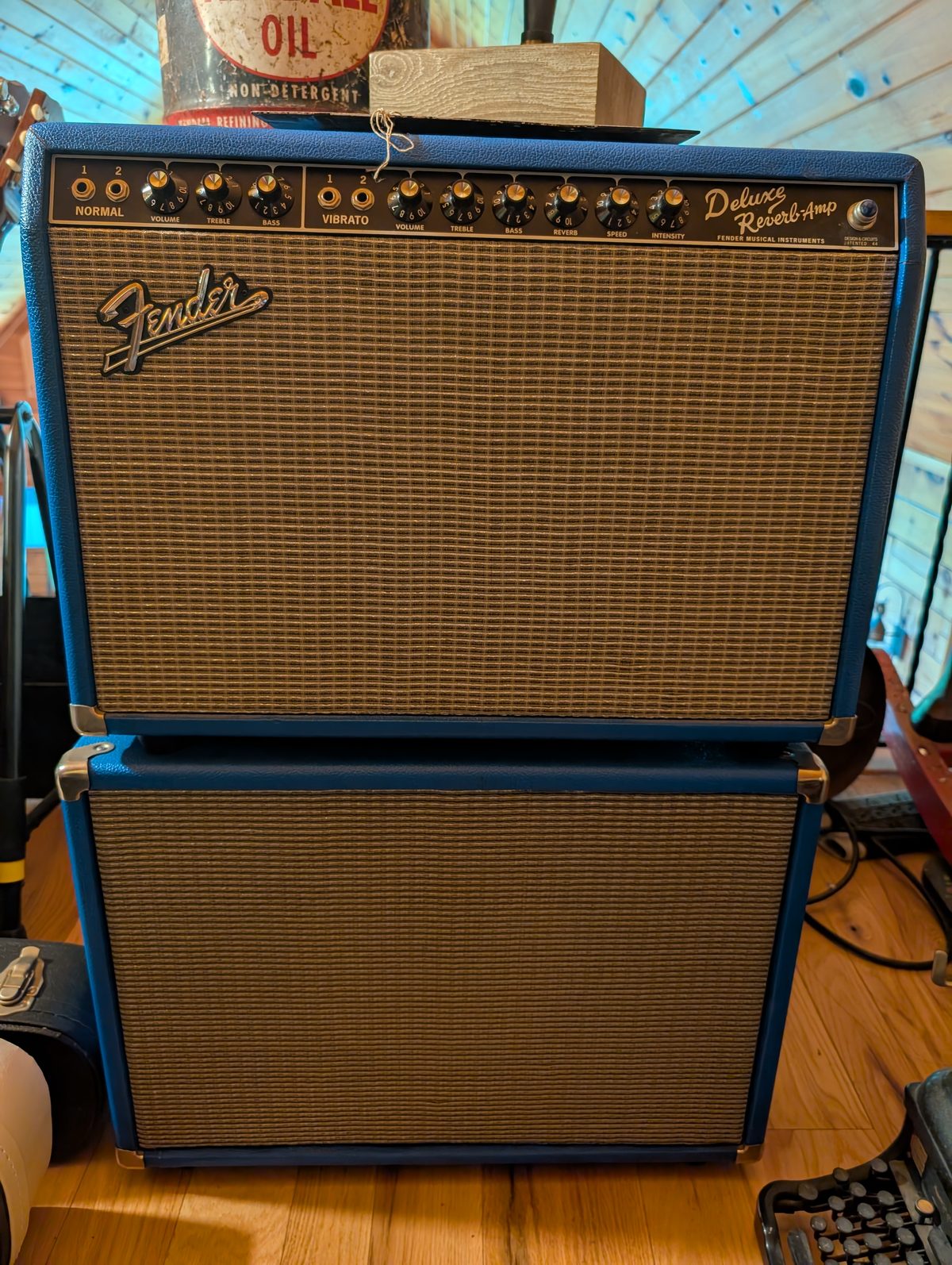 The author’s Deluxe Reverb. Everything on this checklist applies double to anything this pretty, because pretty raises prices faster than function.
Before you go: the market check
Look up sold listings (not asking prices) for the exact model on Reverb. Asking prices are wishes; sold prices are the market. Note the spread, and walk in knowing the number at which the amp is a deal in working condition, because every flaw below subtracts from that number, not from the fantasy number in the ad.
The listening tests (do these in order)
Turn it on and let it warm up quietly. Hiss is normal; crackling, popping, or hum that changes as it warms is not. A loud 60-cycle hum that persists with volume at zero points at filter capacitors, and caps in an older amp that’s never been serviced are a when, not an if (figure $100 to $200 at a tech).
Play clean at conversation volume, then loud. You’re listening for farting or rattling from the speaker (torn or tired cone), notes that bloom into static, or volume that swells and fades on its own (tubes or worse). Bring your own guitar and cable so nothing can be blamed on unfamiliar gear.
Sweep every knob slowly. Scratchy pots are common and cheap to fix (sometimes just contact cleaner), but they’re a haggling line item. A pot with a dead zone is a replacement.
Hit every feature. Reverb: should splash when you thump the amp gently (a dead reverb might be the tank, the cables to it, or the driver circuit; could be $20, could be $150). Tremolo/vibrato: should pulse obviously. Both channels, every input, the footswitch if it comes with one. Features “that just need a little attention” are priced as broken, because they are.
The wiggle test, with permission. Power tubes glowing unevenly, or crackles when you gently tap tubes with a pencil (amp on standby first, then at low volume), mean retubing soon: $60 to $150 in tubes plus a bias job on many amps.
The eyeball tests
Pull the back panel if the seller allows (or use a phone flashlight through vents). You want to see boring: intact original-looking wiring or tidy repairs. You don’t want to see scorch marks, bulging or leaking capacitors, rust on the chassis or transformers (flood or damp storage), or a rat’s nest of amateur soldering. Transformers are the deal-breaker: an output transformer replacement approaches half the value of many amps. Ask directly: “has it been serviced, and is there paperwork?” A recent cap job with a receipt adds value; treat it that way.
Check the serial number and tube chart against the model years online while you’re standing there. Mismatched cabinets, replaced baffles, and “everything’s original” claims that aren’t take real money off vintage prices.
The haggling math
Every line item above has a number: tubes and bias $100ish, cap job $150ish, pot cleaning $50, reverb repair $50 to $150, speaker recone or replacement $80 to $200. Add up what you found, subtract from the sold-listing average, offer that, and show your math. Sellers respect an itemized offer far more than a random lowball, and the checklist just paid for the gas.
One more honest note in the spirit of our modeling essay: buy a used tube amp because you want that amp, its history, its ritual, its resale story, not because you need it to sound good at home volume. The modeler path does that part cheaper. Used tube amps are the vinyl of guitar: buy with your heart, inspect with this list.