
Budda Superdrive Review: The Most Underrated Amp on the Planet (I Own Three)
I’m going to make a bold claim, and I’ve spent two years defending it in a long-running Gear Page thread full of people who own these amps: the Budda Superdrive is, tone for dollar, the most underrated amp on the planet. I own three (an SD18, an SD30, and an SD80), they’re my home and studio amps, and I “accidentally” bought the third one, which tells you everything about how deliberate my relationship with this brand is.
This is the review of an amp line that a proper review never saved, written by someone with no skin in the game beyond wanting company in being right.
The pedigree nobody advertises
Here’s the trivia that should have sold these amps by itself: the Superdrive preamp was designed with help from Dave Friedman, arguably the best preamp mind of his generation (yes, that Friedman), and the power section came from Jeff Bober, one of the great power-amp guys and a driving force behind the whole low-wattage movement. The lineage runs through the Naylor SuperDrive before it, which Friedman has confirmed. Two legends built one amp, the marketing never mentioned it, and Peavey eventually bought the brand and quietly parked it in a corner.
The sound: Plexi shakes hands with Dumble
The Superdrive lives in a space I haven’t found anywhere else at the price: a magical mix between Plexi crunch and Dumble-style smoothness, with legitimately great cleans. The gain is smooth and non-buzzy, blooms when you dig in, and cleans up from the guitar’s volume knob the way the D-style legends are supposed to. I’d actually call it a “D-response” more than a D-sound; it’s more open than the actual Dumble-style amps I’ve played, and better for rhythm work, where the D-clones tend toward mud. Nothing I’ve tried consistently beats it in that space except a Bruno Super 100 and the better Dumble clones, which cost roughly double or more. I’ve A/B’d it in the ballpark of Two Rocks at a big dealer: the Two Rocks were a hair more detailed; I wanted more gain and kept my Buddas.
After two years of thread debate, I’ll amend my claim slightly, and it makes the amp more interesting: this is the most underrated amp on the planet for single-coils. Its strong midrange complements the bite of a Telecaster or a P-90 perfectly, and it gives classic single-coil sounds more usable gain than almost anything that pairs this well. Humbuckers work, but they muddy it a hair, and I suspect decades of marketing it to the humbucker crowd is part of why nobody noticed what it does best.
Why the world missed it (the honest list)
The Superdrive earned its obscurity, and I say that with love. It’s a two-channel amp with no independent masters, so you can’t properly balance the channels; everyone who loves these amps eventually uses them as a single-channel amp and cleans up with the volume knob (an EQ pedal in front makes a fine solo boost, or a volume pot in the effects loop tames the master). They are punishingly loud, with a master taper that jumps from bedroom to eviction with a nudge. They’re purple and a little ugly, which scared off the blues crowd even though Bonamassa played them for a while. They got marketed toward metal, which misses the entire point of the amp (Baroness made it work on Purple, but that’s the exception). A later V series arrived that was honestly a different, lesser amp and confused the market. And there’s no channel indicator light anywhere, which is exactly the kind of decision that summarizes this brand’s relationship with marketing.
None of that list is about tone. That’s the review in one sentence.
Living with them, and making them livable
Practical notes from years of daily use: the 18 and 30 sound close (the 18 a touch brighter and more open, the 30 a bit more compressed), while the 80 has noticeably less sag when pushed, thanks to the power section and rectifier. The stock PHAT 12 speakers are round and midrangey to a fault; swapping to Celestions or, in my case, DV Mark Neo 1x12 cabs brings back crispness and cuts serious weight. The community’s beloved “Brite mod” (a one-capacitor swap Jeff Bober himself will bless) transforms them into something more aggressive if the stock voicing runs dark for you. Mine now live in custom small headboxes, which turned the 18 and 30 into genuinely portable amps; the 80 got a custom cab with my daughter’s name on the badge, because when you own three of something, it’s officially a relationship.
What Jeff built next
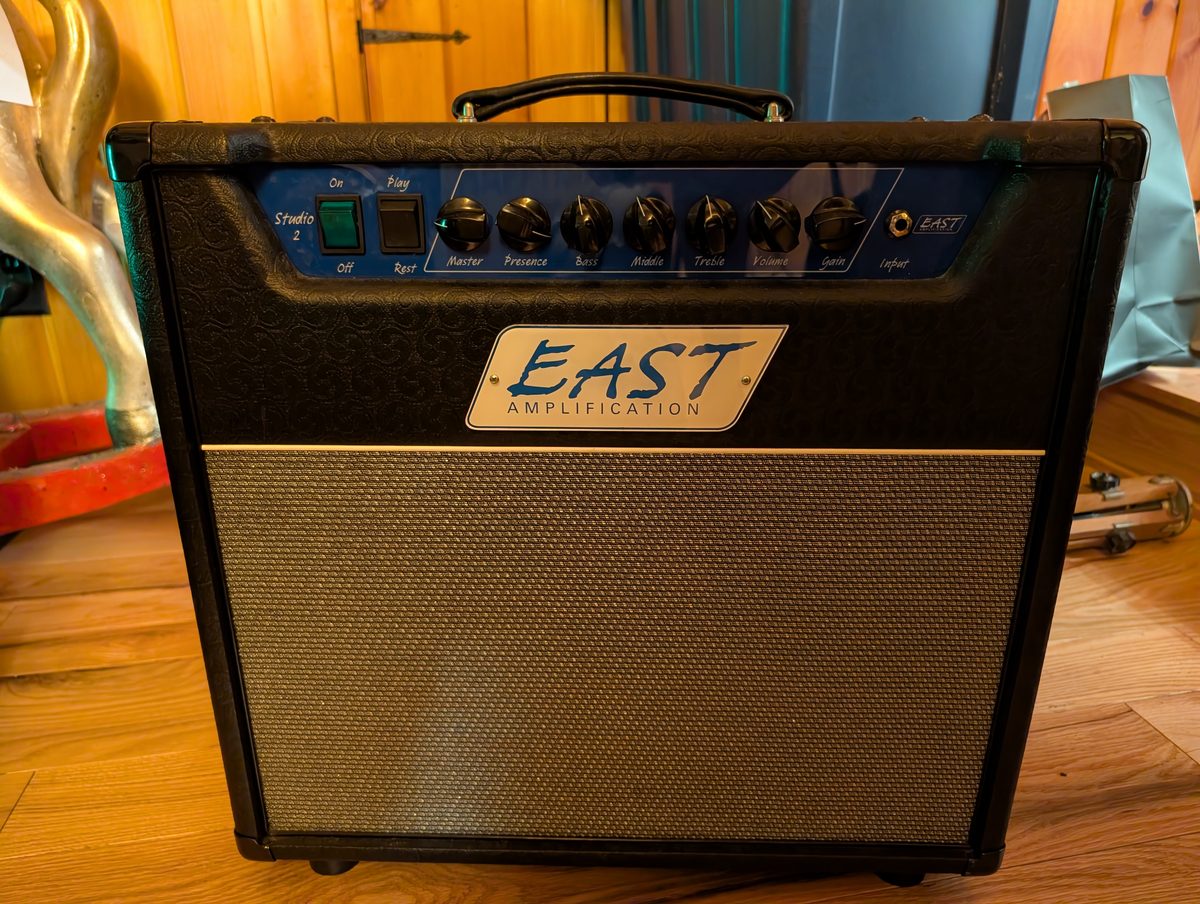 The author’s EAST Studio 2: Jeff Bober’s current company, and the Superdrive lineage continued.
One more chapter for the true believers: Jeff Bober now builds under his own flag as EAST Amplification, and yes, I own one of those too (a Studio 2 combo). It reads like a letter to everyone who loved the Superdrive and kept a list of grievances: single-channel simplicity instead of the awkward two-channel dance, an actual presence control (Budda owners just felt a chill), a proper effects loop and line out, and a Mean/Clean output-stage switch. It’s the same tone family with the quirks engineered out, and a full review is coming. The Superdrives remain the used-market bargain; EAST is where that magic lives new.
Buying one, which is the entire point
Used prices are the punchline of this whole story: SD30 heads trade in the $725 to $800 range, and combos regularly land under $1,000, for hand-wired-era boutique amps (the original Series I SD30s, roughly the first hundred, were fully hand-wired and bulletproof; later Series II PCB builds have proven reliable too). Take the used amp checklist with you, mind that these run hot by design, check which series you’re looking at, and know that no light tells you which channel you’re on, so test both. Then enjoy owning the best-kept secret in used amps, and do keep it a little bit secret, because some of us aren’t done buying them.
Keep reading
-
The Apartment Guitarist's Gear Guide: Great Tone Without the Volume
How to get amp tone you love at apartment volume: modelers, headphone rigs, low-watt amps, and what to skip. Real budgets, honest tradeoffs.
-
Boss Katana vs Positive Grid Spark: Which Practice Amp Fits How You Actually Play?
The two most recommended home practice amps compared honestly: sound, app dependence, gigging headroom, and which player each one actually suits.
-
Modeling Won. The Last Honest Argument for Tubes Is Dying Too.
Blind tests say almost nobody can hear the difference anymore. The holdout argument was 'amp in the room,' and FRFR cabs like Fender's Tone Master FR-12 are ending that one.