
Gibson Custom Shop: What R7, R8, and R9 Actually Mean
Ask a Gibson Custom Shop buyer what an “R9” is and you’ll get a confident answer. Ask most gear content the same question and you’ll get something vague about “the good Les Paul reissue.” The R-number system is actually precise, it’s genuinely useful information before you spend Custom Shop money, and it’s worth explaining properly instead of waving at it.
The R-number system, explained correctly
Gibson Custom’s Historic Reissue Les Pauls are numbered for the specific vintage year and spec set they replicate, and the number isn’t a marketing invention, it maps to real production history at the original Kalamazoo factory.
R7 is the 1957 Les Paul reissue, and what makes 1957 specifically significant is that it’s the year Gibson switched from P-90 pickups to the new PAF humbucker mid-production. Gibson Custom’s R7 replicates the humbucker-era 1957 spec: two Custombucker humbuckers built to the original PAF winding and magnet spec, an ABR-1 tune-o-matic bridge with a separate stopbar tailpiece, and a chunky, full-C neck carve, finished in the period-correct Goldtop. That distinguishes it from Gibson’s earlier-year Goldtop reissues (built around P-90s and, on the earliest years, a wraparound bridge instead of a separate bridge and tailpiece), and it’s a common mix-up worth clearing up before you shop: if you specifically want a P-90 Goldtop with a wraparound bridge, you’re looking at Gibson’s 1954 or 1956 reissue spec, not the R7.
R8 is the 1958 Les Paul Standard reissue, the first year the classic sunburst finish appeared on the Standard. It carries two Custombucker humbuckers, an ABR-1 bridge with a lightweight aluminum stopbar tailpiece, and typically a plain (not heavily figured) maple top, consistent with a lot of real 1958 examples, which were less consistently flamed than what came a year later. Buyers and forums commonly describe the R8’s neck carve as running slightly slimmer and faster than the R9’s, though that’s reputation built up over years of production, not a guarantee on every individual guitar, so play the specific instrument rather than assume the label settles it.
R9 is the 1959 Les Paul Standard reissue, “the Burst,” the single most mythologized Les Paul spec in existence. It shares the R8’s humbuckers, ABR-1 bridge, and stopbar tailpiece, but ships with a figured maple top as the standard spec (not an upcharge), and generally carries a fuller, rounder neck carve than the R8. Here’s the genuinely useful thing most gear coverage skips: the R9 commands a real price premium over the R8, sometimes a substantial one, and that gap is driven overwhelmingly by 1959 originals being the most desired vintage guitars on earth, not by the R9 being a meaningfully better-built instrument than the R8. Both are built by the same Custom Shop, to the same exacting standard, on the same historic-spec production line. If you’re choosing between a clean R8 and a similarly speced R9 purely on tone and build quality, you are largely paying for the number on the truss rod cover, not a construction advantage, and that’s worth knowing before you stretch your budget to chase the higher digit.
The rest of the tier
Beyond the R-series Les Pauls, Custom Shop covers the same historically accurate approach across the rest of Gibson’s catalog: ES-335s, Flying Vs, Explorers, SGs, and more, each built to exacting reproduction standards down to period-correct hardware and, on many finishes, actual nitrocellulose lacquer mixed to vintage formulas rather than a modern equivalent. This is also where most of Gibson’s artist signature models live, guitars built to replicate a specific player’s instrument, sometimes down to replicated wear, non-stock hardware, and documented modifications, built to museum-piece accuracy rather than general-purpose playability.
Street pricing starts around $4,500 and climbs fast from there. Rare specs, figured tops, artist models, and one-off runs all push well past that floor, and it’s not unusual for a heavily documented artist signature piece to run several times the tier’s entry price.
Who this tier is for
Custom Shop makes sense for players who want a specific, historically accurate spec and know enough to ask for it by year and configuration, not just “a nice Les Paul.” It’s also the right tier for anyone who cares about resale into a serious collector market, where R-numbers, finish types, and top figuring all move price in ways they simply don’t at the USA level. It’s the wrong tier for a player who just wants a great-sounding, great-playing Les Paul for gigging and recording: Gibson USA’s Original Collection gets you 90 percent of the tone and playability at half the price, and the gap that’s left is mostly historical accuracy and bragging rights, not something your amp or your audience will notice.
The one Custom Shop instrument I can speak to firsthand rather than describe from spec sheets is my Custom Shop ES-335 with factory P-90s, a rare pickup configuration inside this same tier. It’s the actual owned-and-gigged data point behind everything above about what this level of construction and finish work buys you day to day, years into ownership, not just out of the case.
The honest caveat
Because so much of this tier’s value depends on spec accuracy, top figuring, and originality, the used and collector market for Custom Shop instruments is far more opinion-driven, and far more prone to overpaying, than anything below it. An R9 that’s been refinished, had hardware swapped, or misrepresented in a listing can cost you real money if you don’t know what to check. The used electric guitar checklist matters more at this level than anywhere else on the ladder, not less.
For how Custom Shop stacks up against every other Gibson and Epiphone tier, see the full Gibson and Epiphone lineup guide.
Keep reading
-
Acoustic or Electric First? Pick the One You'll Actually Practice
The honest answer to the most common beginner guitar question, including the finger-pain myth, the real costs of each path, and the one factor that predicts who keeps playing.
-
Buying a Guitar Online Without Playing It First: How to Not Get Burned
Reverb, marketplace, and retailer tactics from someone who's bought and sold online for years: what photos to demand, what questions filter sellers, and when to walk.
-
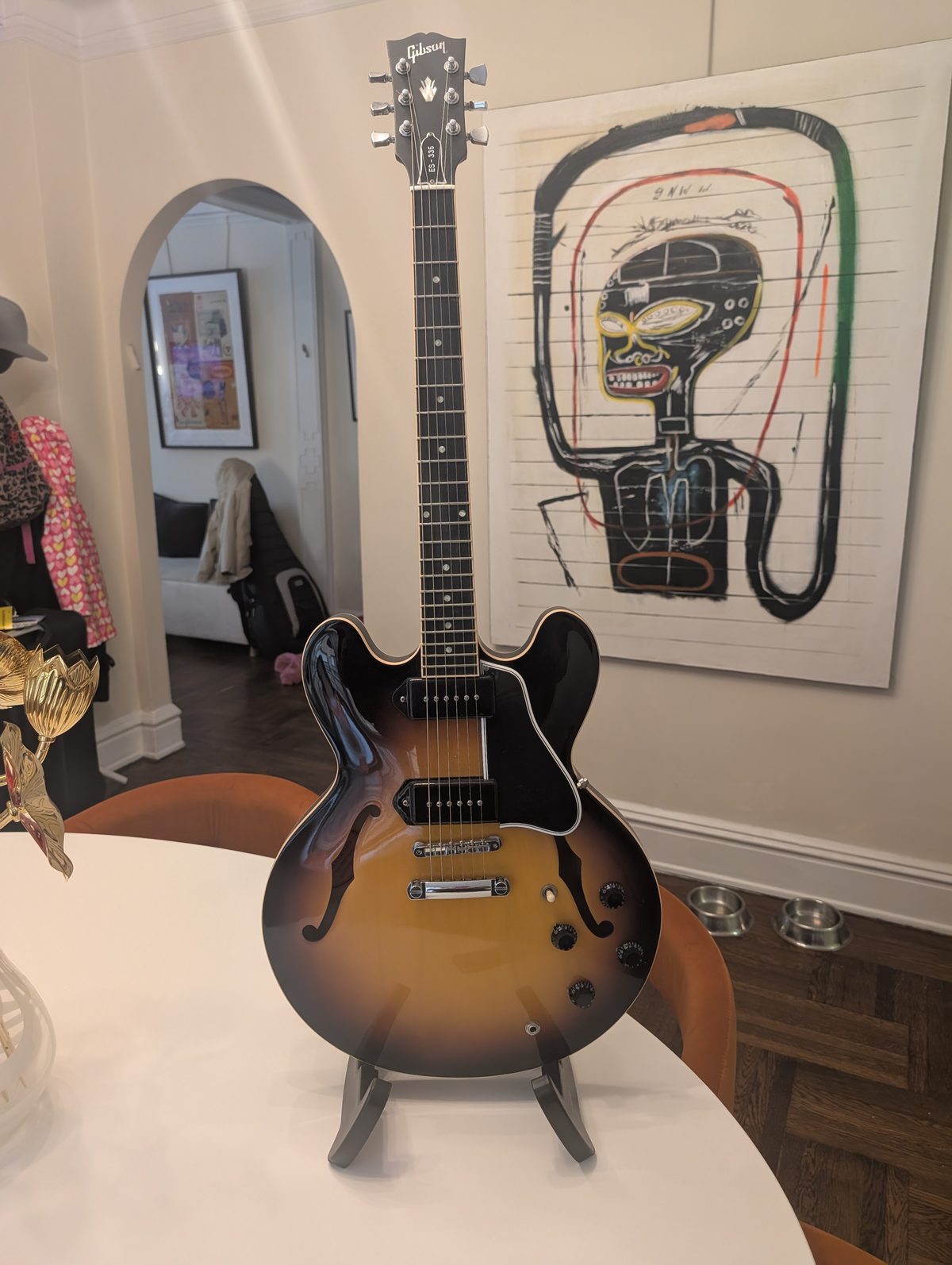
Gibson ES-335 with P-90s: The Rare One, Reviewed After Years of Ownership
A long-term review of the Custom Shop ES-335 with factory dogear P-90s: what the rare pickup swap does to the most famous semi-hollow ever made.