
The Gibson and Epiphone Lineup, Explained: Every Tier From Player Pack to Murphy Lab
Gibson’s family tree is more confusing than Fender’s, because it isn’t one company’s ladder, it’s two brands (Gibson and Epiphone) that used to mean “real” and “cheap copy” and now genuinely overlap in quality at the seams. This is the map: what each tier actually is, who it’s for, and, because I own roughly eight Gibsons and Gibson-family guitars and have played a great many more, exactly where this connects to something I’ve personally lived with versus where it’s an honest spec-and-positioning guide for guitars I haven’t owned. Star ratings stay reserved for the guitars I’ve actually put hours on; everything else here is tiers and facts.
The ladder, top to bottom
Epiphone Player Pack is the true beginner bundle: guitar, small amp, cable, picks, built to get someone playing for a few hundred dollars total. Nobody buys this as an endgame guitar, and nobody should. Full breakdown here.
Epiphone “Inspired by Gibson” is the modern Epiphone core line, and it’s the single biggest quality jump in this entire ladder relative to what the brand used to mean. These are built to Gibson’s own specs (correct body dimensions, real Gibson-licensed pickup designs, proper nitro-adjacent finishes on many models) at a fraction of USA pricing. A good one plays like a genuine alternative to entry Gibson USA, not a copy of one. Full breakdown here.
Epiphone “Inspired by Gibson Custom” goes further: these replicate specific Custom Shop specs, aged hardware options, and higher-grade materials, effectively a budget mirror of Gibson’s own Custom Shop catalog rather than the standard USA line. If a specific historic spec (a particular year’s neck profile, a specific pickup wind) matters to you, check whether this tier already makes it before assuming you need the real Custom Shop. Full breakdown here.
Epiphone Originals covers the semi-hollow and hollow-body family that’s genuinely Epiphone’s own design heritage, not a Gibson clone: Casino, Riviera, Sheraton, Coronet, Wilshire. These aren’t “cheap versions” of a Gibson model, they’re Epiphone’s actual historic instruments, and some of them (the Casino especially, thanks to a certain Liverpool band never using a Bigsby-equipped Gibson) have their own standing in guitar history independent of Gibson entirely. Full breakdown here.
Epiphone Futura Series is the newest addition to the lineup, built around Epiphone’s own contemporary shapes rather than reissuing Gibson designs, aimed at players who want modern ergonomics and output without vintage-replica intent. Full breakdown here.
Gibson USA Original Collection is where the Gibson badge starts: vintage-spec Les Pauls, SGs, ES-models, and the rest, built in Nashville, with period-correct pickups and finishes for players who want the classic recipe with the real name on the headstock. Full breakdown here.
Gibson USA Modern Collection takes the same body shapes and adds contemporary features: slimmer neck profiles, coil-splitting and other switching options, and asymmetrical neck contours on some models, for players who want the Gibson name and tone with less vintage baggage in how it plays. Full breakdown here.
Gibson Custom Shop is the bespoke tier: historically accurate reissues built by dedicated teams, exacting reproductions of specific vintage instruments down to the finish nitrocellulose formula, and the pricing to match. This is also home to most artist signature models built to museum-piece accuracy, and to the R7/R8/R9 Historic Reissue naming system that confuses more buyers than it should. Full breakdown here, including what R7/R8/R9 actually mean.
Gibson Custom Murphy Lab sits at the very top: Custom Shop instruments deliberately aged by Tom Murphy’s team and trained artisans to look and feel decades old, from Light Aged to Heavy Aged to Ultra Light. It’s the most expensive, most polarizing tier on this whole list; you’re either the player who wants a guitar that looks like it survived 1959, or you’re not, and there’s no wrong answer. Full breakdown here.
Where our real review connects
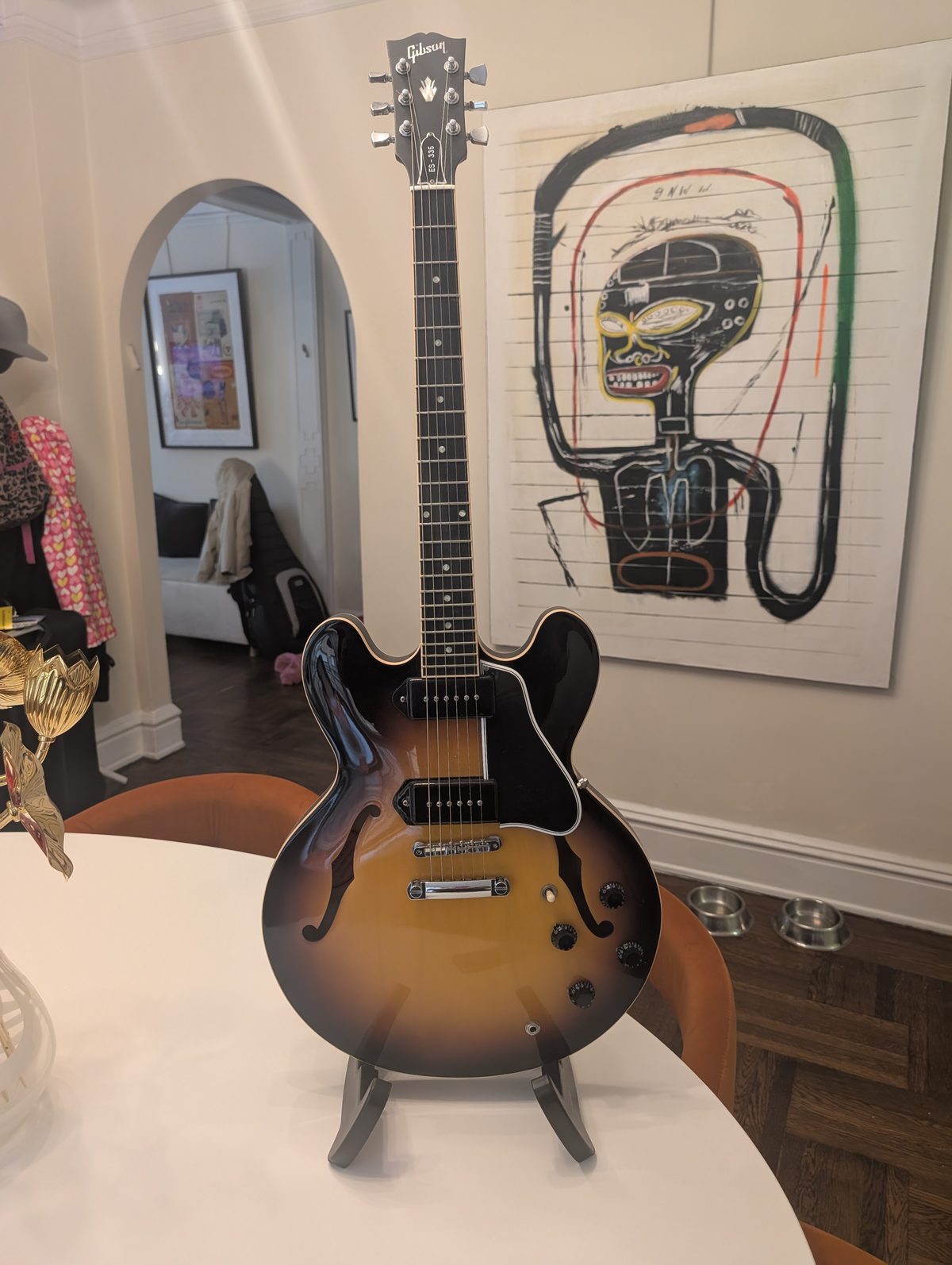
The one place on this entire ladder I can speak to firsthand: my Custom Shop ES-335 with factory P-90s, a rare pickup configuration inside the Custom Shop tier that swaps the standard 335 humbuckers for dogear P-90s. That review is the actual owned-and-gigged data point behind everything I’m saying above about what Custom Shop buys you in build consistency and finish quality, and it’s also a useful case study in a broader truth about this whole ladder: the tier tells you the build quality floor, not the sound, because the sound is mostly the pickups, the wood, and the player. If P-90-versus-humbucker tone is the actual question driving your Gibson shopping, that comparison lives in the pickup guide, not the tier chart.
Where hum, weight, and P-90s change the math
A quick honest note that applies at every tier, Epiphone or Gibson: anything with P-90s hums nearly as much as a Fender single-coil does, which surprises people who assume “not a Strat pickup” means “not noisy.” And solid-body Les Pauls run heavy at every tier; if shoulder fatigue is a real concern, semi-hollow ES-models (this ladder’s construction shows up identically in Epiphone’s Casino and Gibson’s ES-335, just at different price points) are worth trying before you commit to a Les Paul-shaped solution.
Who each tier is actually for
Total beginner: Player Pack, don’t overthink it. Serious student or first real electric on a budget: Epiphone Inspired by Gibson, full stop, it’s the best value jump on this entire list. Chasing a specific vintage spec without Custom Shop money: Inspired by Gibson Custom. Want Epiphone’s own design heritage, not a Les Paul clone: Originals. Want modern ergonomics in Epiphone’s own shape language: Futura. Want the real badge with vintage-correct specs: Gibson USA Original Collection. Want the real badge with modern playability: Gibson USA Modern Collection. Commissioning a historically exact instrument: Custom Shop. Want that Custom Shop instrument to look like it’s been gigged since the Eisenhower administration: Murphy Lab.
Same rule as the Fender guide: this is a map, not a verdict on any specific guitar. Play the actual instrument in front of you before you trust any tier chart, mine included, and if you’re buying used at any level, run the same checklist regardless of what the headstock says.
Frequently asked questions
What's the difference between Epiphone and Gibson?
Epiphone is Gibson's more affordable sister brand, built overseas rather than in Nashville. Modern Epiphone "Inspired by Gibson" models are built to Gibson's own specs with real Gibson-licensed pickup designs, and a good one plays like a genuine alternative to entry-level Gibson USA at a fraction of the price, not a cheap copy of one.
What do R7, R8, and R9 mean on a Gibson Custom Shop Les Paul?
They're Gibson Custom's Historic Reissue numbers, and each maps to a specific vintage year and spec set: R7 replicates the 1957 Les Paul (the year Gibson switched from P-90s to PAF humbuckers), R8 replicates the 1958 Les Paul Standard, and R9 replicates the famous 1959 Standard, the most mythologized vintage Les Paul spec in existence. The full breakdown, including why R9 costs more than R8 despite similar construction, is in the Gibson Custom Shop guide.
Is Epiphone Inspired by Gibson actually good?
Yes, and it's arguably the single best value jump on the entire Gibson/Epiphone ladder. Real Gibson-licensed pickups, correct body dimensions, and proper finishes at a fraction of Gibson USA pricing make it a genuine alternative to entry-level Gibson USA, not just a budget copy.
What's the newest tier in the Gibson and Epiphone lineup?
Epiphone Futura Series is the newest addition, built around Epiphone's own contemporary shapes rather than reissuing existing Gibson designs, for players who want modern ergonomics and output without vintage-replica intent.
Keep reading
-
Acoustic or Electric First? Pick the One You'll Actually Practice
The honest answer to the most common beginner guitar question, including the finger-pain myth, the real costs of each path, and the one factor that predicts who keeps playing.
-
Buying a Guitar Online Without Playing It First: How to Not Get Burned
Reverb, marketplace, and retailer tactics from someone who's bought and sold online for years: what photos to demand, what questions filter sellers, and when to walk.
-
Gibson ES-335 with P-90s: The Rare One, Reviewed After Years of Ownership
A long-term review of the Custom Shop ES-335 with factory dogear P-90s: what the rare pickup swap does to the most famous semi-hollow ever made.