
Epiphone Originals: Not Gibson Copies, Epiphone's Own History
Most of the Epiphone catalog exists in Gibson’s shadow by design, built to Gibson specs, positioned against Gibson models, priced beneath Gibson equivalents. The Originals line is the exception, and it’s worth understanding why before writing it off as “the cheap semi-hollow section.” The Casino, Riviera, Sheraton, Coronet, and Wilshire are Epiphone’s own historic instruments, designed and sold under the Epiphone name well before Gibson acquired the company, and they’ve never been reissues of a Gibson model in the first place.
The Casino’s independent history
The clearest case is the Casino, a fully hollow archtop that looks like a 335 relative but isn’t built like one at all, no center block, true hollow construction, which gives it a looser, more feedback-prone, more acoustically alive character. Its cultural footprint is arguably bigger than most guitars in the entire Gibson catalog: it’s the guitar a certain Liverpool band played through their most famous studio years, at a time when they specifically weren’t reaching for a Bigsby-equipped Gibson semi-hollow. That’s not a footnote borrowed from Gibson’s history, it’s the Casino’s own.
What’s actually in these guitars
Construction varies by model but the family shares real hollow or semi-hollow bodies (true hollow on the Casino and Wilshire, semi-hollow with a center block on the Riviera and Sheraton), laminated maple tops, and set necks. P-90s show up constantly across this line, especially on the Casino and Coronet, which is the single biggest thing to understand before buying in: P-90s behave much closer to a single-coil than a humbucker, with real 60-cycle hum and a brighter, more percussive attack than the smoother voicing on the Riviera and Sheraton. If you’re deciding whether that’s the sound you want, the single-coil versus P-90 versus humbucker breakdown covers the actual tonal differences, and the closest thing to a firsthand, long-term data point on this exact pickup-in-a-semi-hollow combination is a Custom Shop ES-335 built with factory P-90s — a Gibson rather than an Epiphone, but it demonstrates precisely what this pairing does to a hollow or semi-hollow instrument.
Where this sits against the rest of the ladder
Materials and build quality land roughly alongside the standard Inspired by Gibson tier, sometimes a touch above given the more involved hollow-body construction. But this isn’t a spec-matching exercise against a Gibson model the way Inspired by Gibson is; there’s no Gibson Casino to match specs against, so the comparison only works in build-quality terms, not blueprint terms.
Notable models
The Casino is the obvious headline and the best-known instrument in the family by a wide margin. The Sheraton is the more refined semi-hollow option, closer in spirit to an ES-335 with a fancier appointment package and a center block that tames some of the Casino’s feedback tendencies. The Coronet is the solid-body outlier in the lineup, a simple single-P-90 slab that trades the hollow-body complications for straightforward rock and roll snap.
Who should buy it, and who’s wasting money
This tier is for players who want a genuinely different sound and feel from the Les Paul and SG shapes that dominate the rest of the catalog: jangle, air, feedback-friendly grit, and P-90 bite, typically at $600-$900 street. It’s also a strong pick for anyone drawn to the Casino specifically for what it represents historically rather than as a Gibson stand-in. It’s the wrong choice for high-gain players who’ll fight hollow-body feedback at volume, and for anyone who actually wants a 335-style humbucker tone, since nothing in this family replicates that.
The honest caveat
Hollow and semi-hollow construction means more feedback sensitivity at stage volume than anything solid-body on this ladder, and P-90 hum is a real, constant companion, not an occasional annoyance. Buy this family for what it does well rather than expecting it to also cover high-gain or noise-sensitive recording work.
For where this family sits against every Gibson and Epiphone tier, see the full Gibson and Epiphone lineup guide.
Keep reading
-
Acoustic or Electric First? Pick the One You'll Actually Practice
The honest answer to the most common beginner guitar question, including the finger-pain myth, the real costs of each path, and the one factor that predicts who keeps playing.
-
Buying a Guitar Online Without Playing It First: How to Not Get Burned
Reverb, marketplace, and retailer tactics from someone who's bought and sold online for years: what photos to demand, what questions filter sellers, and when to walk.
-
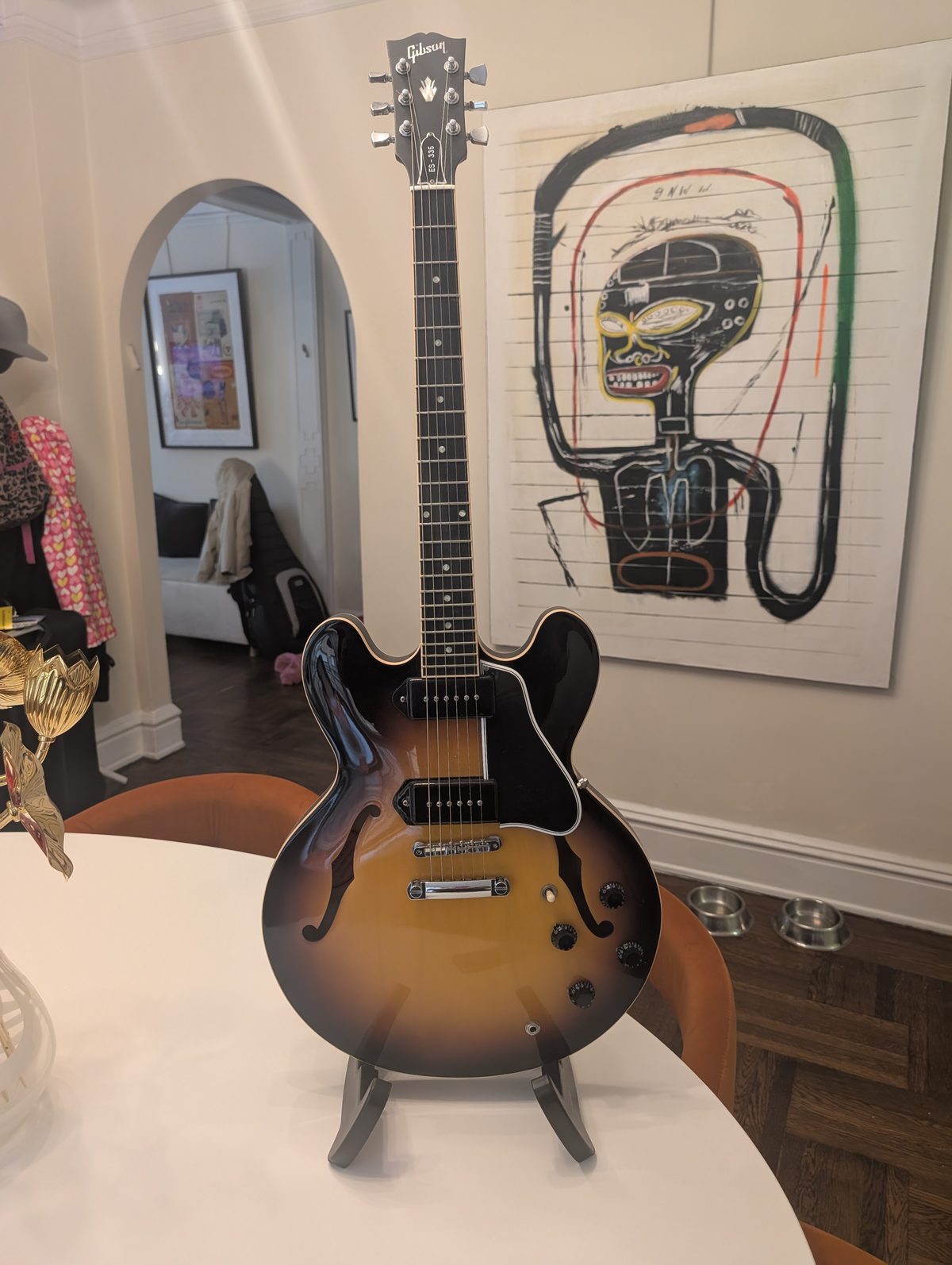
Gibson ES-335 with P-90s: The Rare One, Reviewed After Years of Ownership
A long-term review of the Custom Shop ES-335 with factory dogear P-90s: what the rare pickup swap does to the most famous semi-hollow ever made.