
The Guitar Gear Glossary: Every Term Explained in Plain English

This is the page I wish existed the first few years I was buying gear. You’re reading a review or some forum thread, someone drops a term like “negative feedback loop” or “compound radius” like everyone just knows what that means, and you don’t want to derail the conversation to ask. So here it is, one page, every term defined plainly, no philosophy lecture attached. I’ll keep adding to this as terms come up.
Guitar terms
Tonewood: The type of wood used in a guitar’s body and neck, historically believed to shape the instrument’s tone. On electrics the effect is real but smaller than most forum arguments suggest, since pickups, strings, and setup do most of the work. On acoustics it matters a lot more because the wood itself is the amplifier.
Scale length: The distance from the nut to the bridge saddle, measured in inches. Longer scales (25.5” on a Strat) feel tighter and brighter with more string tension at pitch, shorter scales (24.75” on a Les Paul) feel looser and warmer.
Radius (fretboard): How curved the fretboard is across its width, measured in inches (a smaller number means more curve). A flatter radius is easier for bending and shredding without notes choking out, a rounder radius feels more comfortable for chords and rhythm playing.
Compound radius: A fretboard that gets flatter as it moves from the nut toward the body, combining comfortable chord shapes up top with clean high bends further down. Common on modern shred-oriented and superstrat-style necks.
Nut width: The width of the neck measured at the nut, which determines how cramped or spread out the string spacing feels in your hand. Classical and some vintage-style necks run wider, most modern electrics sit in a narrower, faster-feeling range.
Action: How high the strings sit above the frets. Lower action is easier to fret but can buzz more, higher action gives more room for the string to vibrate but takes more finger effort.
Intonation: Whether a guitar plays in tune with itself up and down the neck, not just when open. Set by adjusting saddle position so a fretted note at the 12th fret matches the harmonic at the same spot.
Truss rod: A steel rod running through the neck that counteracts the pull of string tension, adjustable to add or remove relief (forward bow) in the neck.
Relief: The slight forward bow in a neck, usually a small fraction of an inch, that gives vibrating strings room to move without buzzing. Too much relief makes a guitar feel stiff in the middle of the neck, too little causes fret buzz.
Fret level vs refret: A fret level files down high spots so all the frets sit at a consistent height, restoring clean action without replacing anything. A refret pulls the old frets and installs new ones, needed once frets are worn down too far to level again.
Nitro vs poly finish: Nitrocellulose lacquer is thin, ages and yellows over time, and dents more easily, while polyurethane and polyester finishes are thicker, more durable, and resist wear better. The tonal difference between the two is debated and probably smaller than the durability difference.
Bolt-on vs set neck vs neck-through: A bolt-on neck attaches with screws and is easy to adjust or replace, a set neck is glued in for (arguably) better sustain and a smoother heel, and neck-through construction runs the neck wood straight through the body for maximum sustain at the cost of repairability.
Roasted maple: Maple that’s been heat-treated (baked) before being shaped into a neck, which reduces moisture content, makes the wood more stable against humidity changes, and gives it a darker, toasted appearance.
Locking tuners: Tuning machines with a clamp built into the post that grips the string directly, cutting down on slippage and making string changes and tuning stability noticeably better than friction-fit posts.
Floating vs hardtail bridge: A floating (tremolo) bridge pivots to let you raise or lower pitch with a bar, but goes out of tune more easily and shifts the tuning of every string if one breaks. A hardtail bridge is fixed in place, simpler, and generally more tuning-stable.
Humbucker: A pickup made of two coils wired to cancel out (buck) the 60-cycle hum that a single coil picks up, generally fatter and higher output than a single-coil.
Single-coil: A pickup with one coil of wire around magnets, known for a brighter, more detailed, sometimes glassier tone, at the cost of picking up more electrical hum.
P-90: A single-coil pickup design that’s physically larger and wound differently than a Strat or Tele-style single-coil, landing tonally between a single-coil and a humbucker, with more grit and midrange push than either.
Coil-split: A switching option on a humbucker that shuts off one of its two coils, turning it into something close to a single-coil tone. Not identical to a real single-coil, but a useful in-between option.
Active vs passive pickups: Passive pickups are just wire and magnets, sent straight to the output jack. Active pickups include a small onboard preamp powered by a battery, giving a hotter, more consistent, often more compressed and scooped-sounding output.
Output and impedance: Output is how strong a pickup’s signal is, roughly correlating with perceived loudness and grit. Impedance is a measure of electrical resistance in the circuit that affects tone and how the pickup interacts with cables, pedals, and amp input stages, longer cables and lower-impedance-friendly gear generally preserve more high end.
Amp terms
Tube rectifier vs solid-state rectifier: The rectifier converts AC power to DC for the amp to use. A tube rectifier does this more slowly and “sags” under heavy playing, giving a softer, more compressed feel, a solid-state rectifier responds instantly and stays tight and firm under the same conditions.
Class A vs Class AB: These describe how the power tubes are biased and operate. Class A amps run their tubes on for the full signal cycle, generally lower wattage, earlier breakup, and a warmer feel. Class AB amps split the work between tube pairs, generally more headroom and efficiency at higher wattage.
Headroom: How much clean volume an amp has before the power section starts to distort. High-headroom amps stay clean at higher volumes, low-headroom amps break up earlier.
Breakup: The point where a clean tone starts to distort and compress as you push the amp harder, either from volume, pick attack, or the guitar’s own volume knob.
Master volume: A separate volume control (in addition to the main gain knob) that lets you dial in preamp distortion at a lower overall output volume, useful for getting a cranked tone at bedroom-friendly levels.
Negative feedback loop: A circuit that sends some of the power amp’s output signal back to an earlier stage out of phase, tightening up the bass response and taming harshness. Amps with the feedback loop removed or reduced tend to feel looser and more touch-sensitive, at the cost of some tightness.
Reverb, spring vs digital: Spring reverb uses physical springs and a transducer to create a natural, slightly splashy, mechanical-sounding reflection of the signal, built into many combo amps. Digital reverb uses processing to simulate reverb algorithmically, and can convincingly model spring tanks or generate spaces springs never could, like halls and plates.
Tremolo (amp) vs vibrato (string bending): On an amp, tremolo is a rhythmic pulsing of volume. Vibrato is a pulsing of pitch, like what you do bending a string back and forth with your fretting hand. Fender famously mislabeled these on many amps decades ago (calling amp tremolo “vibrato” and vice versa), and the mixed-up naming stuck around in guitar culture ever since.
Presence control: A tone control, usually part of the power amp stage, that adjusts upper-midrange and treble content in a way that affects perceived clarity and “cut” more than a normal treble knob does.
Tone stack: The set of EQ controls (typically bass, mid, treble) built into an amp’s preamp section, and the specific circuit arrangement behind them, which varies by amp design and has a big effect on how those knobs interact with each other.
Watts vs perceived loudness: Wattage is a measure of power output, not a direct measure of loudness. Because of how amp headroom and speaker efficiency work, doubling the wattage doesn’t double how loud something sounds, and a low-wattage tube amp can often feel louder in a room than its number suggests.
Combo vs head and cab: A combo amp has the amplifier and speaker built into one cabinet. A head-and-cab setup separates the amplifier (head) from the speaker cabinet, letting you mix and match different cabs or run more speakers.
Impedance matching (amp/cab): Tube amp output stages need to see a cabinet impedance (measured in ohms) that matches what the amp is set for, mismatching this can damage the output transformer, so always match the amp’s output setting to the cab’s rated impedance.
FRFR: Short for “full range, flat response,” a type of speaker or cabinet designed to reproduce a signal accurately without coloring it, the way a studio monitor or PA speaker does, commonly paired with modeling amps and profilers instead of a traditional guitar cabinet.
Modeling amp / profiler: A modeling amp uses digital processing to simulate the sound and behavior of various amps and cabinets from a library of built-in models. A profiler, like a Kemper, instead captures (“profiles”) the sonic characteristics of an actual physical amp and cab so you can recall that specific captured tone later.
Cabinet simulation (cab sim): Digital processing that mimics the frequency response of a guitar speaker cabinet and microphone, used to make a direct signal (from a modeler, pedal, or amp’s DI out) sound like it was mic’d from a real cab instead of sounding thin and harsh.
DI (direct input): A way of sending a guitar or amp’s signal straight into a mixer, interface, or PA without going through a mic’d speaker, often using a DI box to match impedance and levels properly. Common in modeling and profiler rigs, and for recording direct with cab simulation after the fact.
Pedal and effects terms
True bypass: A bypass design where, when the pedal is off, your signal runs through a direct mechanical path with no electronics in the way at all, as if the pedal weren’t there.
Buffered bypass: A bypass design where the signal still passes through a buffer circuit even when the pedal is off, which can help preserve high end and drive strength over long cable runs or big pedalboards, at the cost of it technically always being “in the signal path.”
Signal chain / pedal order: The order pedals are connected in, which changes how they interact. The general convention is dynamics and pitch effects first, then gain (drive/distortion), then modulation, then time-based effects (delay, reverb) last, though plenty of great tones break that rule on purpose.
Analog vs digital pedals: Analog pedals process the actual electrical signal through analog circuitry the whole way through. Digital pedals convert the signal to digital, process it, and convert it back, generally allowing more complex effects and presets at the cost of some purists’ preference for analog’s feel and character.
Pedal power: How pedals get electricity, either from a battery or a power supply, and the practical details that matter (voltage, polarity, milliamp draw, isolated outputs to prevent noise) when running more than one or two pedals off a shared supply.
Gain staging: Managing signal level at each stage of a chain (guitar, pedals, amp) so nothing clips or gets too weak before it needs to. Poor gain staging can mean unwanted distortion earlier in the chain, or a signal so weak later stages have nothing usable to work with.
Boost: A pedal or circuit that increases signal level and/or drive without necessarily adding audible distortion of its own, often used to push an already-driven amp or pedal into more saturation, or just to raise volume for a solo.
Tone and recording-adjacent terms
Headroom vs breakup (again, because it comes up everywhere): Headroom is the clean ceiling before distortion starts, breakup is what happens once you cross that ceiling. Low headroom means breakup happens sooner and more gradually, high headroom means the tone stays clean until it suddenly doesn’t.
Output impedance: How much a device resists the flow of the signal it’s sending out, which affects how it interacts with whatever it’s plugged into next, high-impedance sources paired with poorly matched low-impedance inputs can lose high-end detail.
Signal-to-noise ratio: The relationship between your actual signal and the background hiss or hum riding along with it. Higher output pickups, cleaner power supplies, and shielded cabling all tend to improve this.
Mic’ing a cab: Placing a microphone in front of (or near) a guitar speaker cabinet to capture its sound for recording or live sound, as opposed to going direct. Mic position (dead center of the speaker cone versus off toward the edge) changes the brightness and character of the captured tone significantly.
Want the longer version of any of these
A handful of these terms have full articles on the site if a one-paragraph definition doesn’t cut it. Start with scale length or buffered versus true bypass if you want the deeper dive, or check pedal order if you’re actually building a board right now instead of just reading about one.
Keep reading
-

Acoustic or Electric First? Pick the One You'll Actually Practice
The honest answer to the most common beginner guitar question, including the finger-pain myth, the real costs of each path, and the one factor that predicts who keeps playing.
-

Buying a Guitar Online Without Playing It First: How to Not Get Burned
Reverb, marketplace, and retailer tactics from someone who's bought and sold online for years: what photos to demand, what questions filter sellers, and when to walk.
-
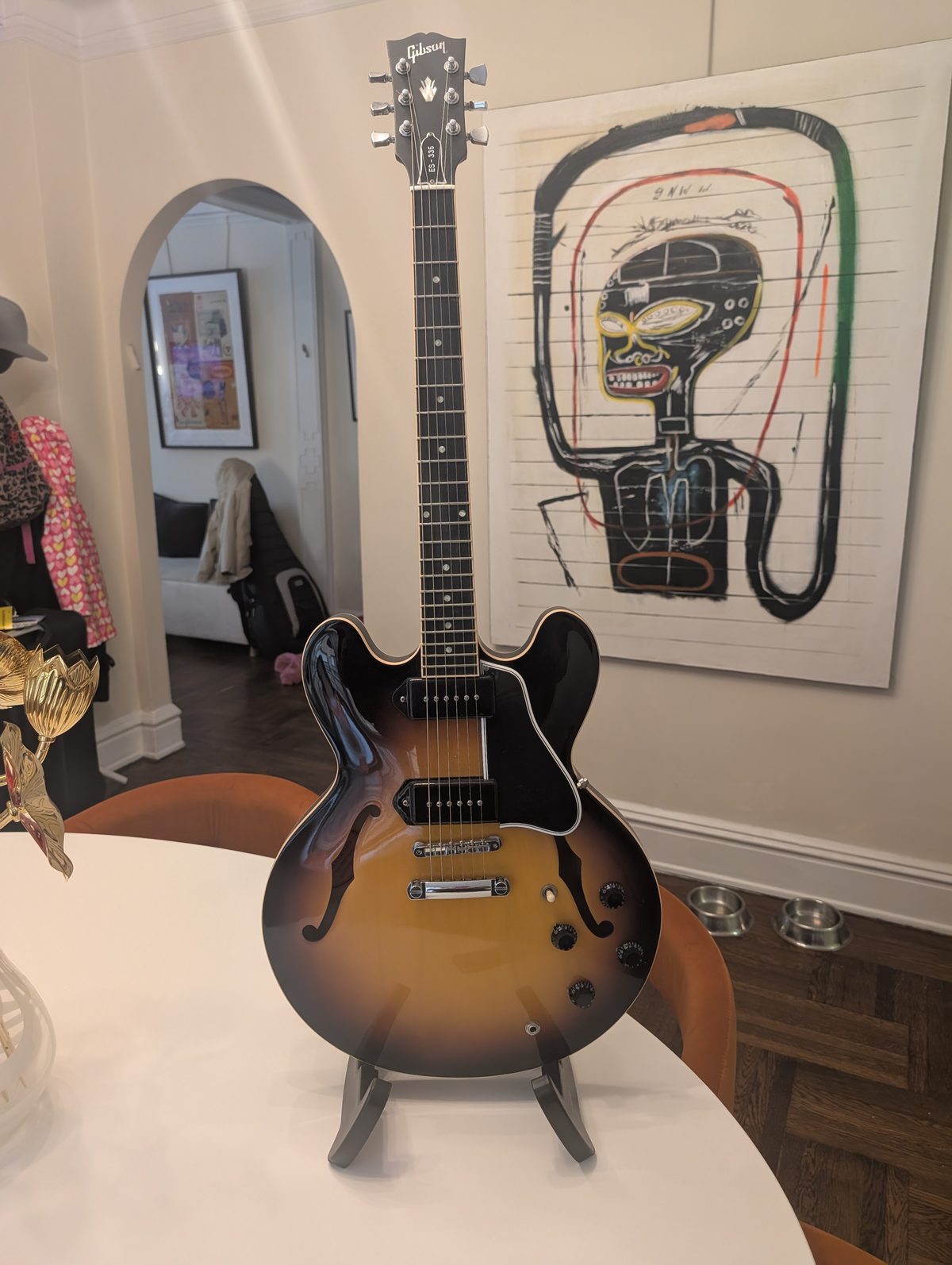
Gibson ES-335 with P-90s: The Rare One, Reviewed After Years of Ownership
A long-term review of the Custom Shop ES-335 with factory dogear P-90s: what the rare pickup swap does to the most famous semi-hollow ever made.